Write an Original Word Clue: Meaning, Length and Fairness
Making a small puzzle is a useful way to understand solving. Choose an answer, write a fresh clue and check that the supplied letters and meaning support it. A fair exercise gives enough information without depending on a private association.
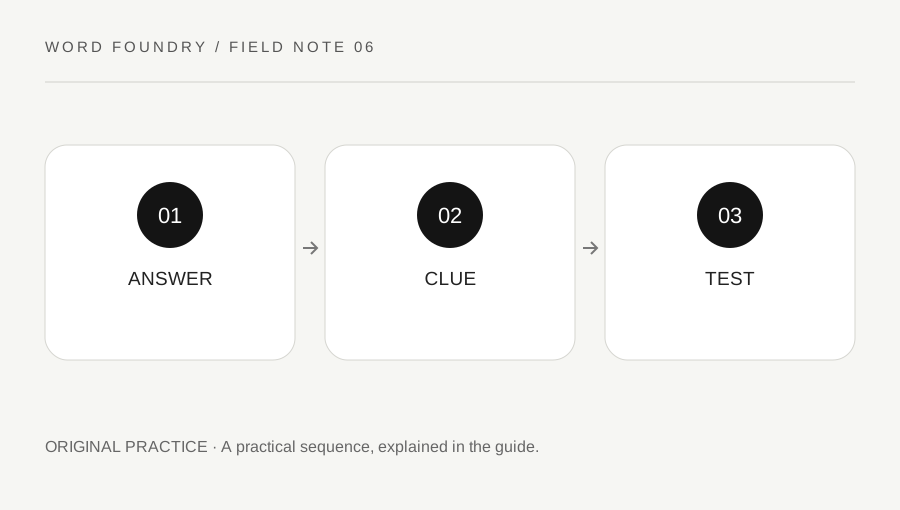
Original explanatory diagram. Numerical examples in this guide illustrate the reasoning; they are not a claim of hands-on testing.
Choose a manageable answer
Start with an ordinary word whose spelling and meaning you can verify. Decide whether your exercise is a fixed-position pattern, a full anagram or a short vocabulary question. These formats supply different information. An anagram uses all supplied letters, while a pattern fixes selected positions and may leave the rest open.
Write the answer privately before composing the clue. Check its exact letter inventory, especially repeated copies. Avoid selecting an unfamiliar word solely because a tool suggests it. You should be able to explain the intended sense and write an original sentence using it before asking someone else to solve your exercise.
Describe the intended sense in fresh words
Write a concise description of the sense you mean without copying a dictionary definition or a published puzzle clue. For WINDOW, you might describe a glazed opening in a wall. Keep the grammatical role aligned: a noun answer usually needs a noun-style description, unless you deliberately introduce and explain a different puzzle mechanism.
Read the wording for accidental ambiguity. A broad clue such as something in a house could point to hundreds of answers. Add a meaningful distinguishing feature instead of an arbitrary personal hint. Your childhood nickname for an object may be vivid to you but gives an unfamiliar solver no fair route to the answer.
Supply the right constraints
For a pattern exercise, choose which positions to reveal and count the unknown slots. For an anagram, preserve every letter occurrence when scrambling. A six-letter answer with two copies of one letter must still supply those two copies. Check the scrambled string mechanically or with a handwritten frequency table.
If more than one word can be made from the same letters, the clue must distinguish the selected answer. Do not claim mathematical uniqueness unless you have a suitable complete lexicon and have checked it. Our small practice vocabulary can help explore alternatives, but its missing entries cannot establish that no other English anagram exists.
Ask someone to explain their route
Test the exercise with a person who has not seen the answer. Ask what each part of the clue suggested and whether the supplied pattern or letters helped. A wrong answer that fits both the constraints and the clue may reveal that the exercise needs revision rather than that the solver failed.
For an illustrative test, use the answer GARDEN and a fresh clue about a cultivated place for plants. If the solver proposes a different six-letter word, compare its letters and meaning carefully. Add a useful distinction if needed. Preserve the original clue and the revision so you can see what made the task clearer.
Publish with a transparent answer check
Keep the answer, explanation and any accepted alternatives together in your own materials. State whether every supplied letter must be used and what a question mark means. If you provide a reveal button, make its effect clear and allow learners to keep thinking before using it. Assistance should be a visible choice.
Do not borrow a commercial daily puzzle's clues, branding or answer schedule to make the exercise appear affiliated. Original small exercises can stand on their own. After someone solves, invite a short explanation of the letter counts or meaning. That final review turns a one-word answer into a reusable learning observation.
A practical checklist
Tick items for your own use. This checklist is saved only in this browser.
Questions that come up
May I copy a dictionary definition as a clue?
Write an original description instead and consult the dictionary to verify meaning. Definitions and published clues can be protected text. A fresh clue also lets you tune the wording to your own exercise.
Does one helper result prove a unique answer?
No. A limited vocabulary can omit alternatives. Treat the clue and constraints as a practical exercise, and avoid claiming exhaustive uniqueness without a suitable complete reference and a real check.
What if a tester gives another fitting answer?
Compare its spelling and meaning honestly. Accept it where appropriate or revise the clue to distinguish the intended sense. A fair alternative is useful feedback about the exercise design.
References & scope
Background references checked on 18 October 2026. The examples and practice exercises are original editorial explanations, not copied procedures or professional advice.
- Cambridge Dictionary: word formation
- Merriam-Webster: dictionary lookup
- Merriam-Webster: official game dictionary lookup
- Cambridge: compounds and written forms
- Cambridge: colour and color usage labels
- Merriam-Webster: homophone terminology
- Merriam-Webster: palindrome terminology
- Merriam-Webster: thesaurus sense grouping