Check a Dictionary Entry by Sense, Not Just by Headword
Finding a spelling in a dictionary is only the first step. The intended meaning, part of speech, usage label and form must fit the clue or sentence. A careful entry check prevents a familiar headword from lending false confidence to the wrong sense.
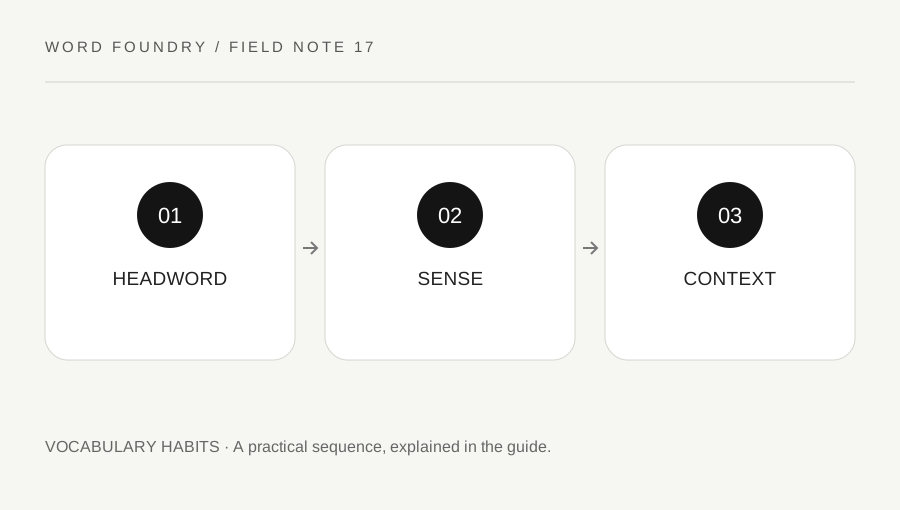
Original explanatory diagram. Numerical examples in this guide illustrate the reasoning; they are not a claim of hands-on testing.
Confirm the exact written form
Enter the candidate accurately and check whether the reference redirects to another form. Note spaces, hyphens, inflections and variants. A search suggestion can be useful but is not the same as an entry for the exact form you intended. Keep the original candidate visible while checking.
Use a suitable reputable reference for the task. A general dictionary explains language, while a designated game lexicon determines acceptance under particular rules. Do not assume either source answers every question the other addresses. The helper on this site supplies neither copied definitions nor official validity rulings.
Read the relevant sense and grammar
A headword can have several meanings and grammatical roles. For BANK, a clue about the side of a river points to a different sense from one about a financial institution. Merely seeing BANK at the top of an entry does not establish that an invented use fits.
Compare the clue's grammar too. A verb request, plural noun or past-tense context can require a different form. Write a short original sentence that uses the proposed sense. If the sentence feels strained, inspect the reference again instead of assuming the pattern match settles meaning.
Check labels and limitations
Usage labels can identify regional, specialist, dated or informal contexts. Read them with the actual task in mind. An old or specialist sense may be valid language but unlikely in a beginner exercise unless the clue provides adequate support. Do not remove the label when creating your own explanation.
For an original clue, choose a sense you can describe accurately in fresh words and verify any uncertain detail. Do not copy a dictionary's full definition or example sentence into a published answer key. Reference checking supports accuracy; it is not a license to reproduce the source text wholesale.
Record what was verified
Keep the headword, intended sense in your own words, part of speech and source link. Add an original sentence and the constraint that mattered in the puzzle. This creates a useful small note without accumulating pages of copied entries. If a form remains uncertain, label that uncertainty instead of quietly normalizing it.
After verification, return to the actual pattern or rack. A correct meaning cannot repair an incompatible letter count, and a correct spelling cannot repair the wrong sense. Treat dictionary reading and mechanical matching as complementary checks. The final answer should satisfy both under the stated vocabulary policy.
Write a two-sense verification note
For BANK, create one original sentence about a river edge and another about a financial institution. Label the intended noun sense for each. Consult a suitable dictionary to verify the meanings, then summarize them in your own brief wording rather than copying the entry.
Next create a fixed-position pattern for the same spelling. Notice that the mechanical match cannot distinguish the two senses; only the clue or context can. Add a column to your note for the evidence that chose the sense. This small exercise is a useful guard against treating a dictionary headword as a blanket endorsement of every imagined meaning. Keep source links for later review and note any regional or specialist label that materially affects the intended use. The final explanation should connect the verified sense to the actual clue.
Revisit the note after solving and confirm that the final clue interpretation still matches the verified sense. A changed crossing can reveal that the original meaning assumption needs revision.
A practical checklist
Tick items for your own use. This checklist is saved only in this browser.
Questions that come up
Is seeing the headword enough?
No. A word can have several senses and grammatical roles. Check the meaning and form that fit the actual clue or sentence.
Can I copy the definition into my exercise?
Write an original description and sentence, using the reference to verify accuracy. Definitions and examples can be protected text and should not be reproduced wholesale.
Does a general dictionary settle game acceptance?
Not always. A particular game or competition can designate its own lexicon and category rules. Check that policy separately.
References & scope
Background references checked on 18 October 2026. The examples and practice exercises are original editorial explanations, not copied procedures or professional advice.
- Cambridge Dictionary: word formation
- Merriam-Webster: dictionary lookup
- Merriam-Webster: official game dictionary lookup
- Cambridge: compounds and written forms
- Cambridge: colour and color usage labels
- Merriam-Webster: homophone terminology
- Merriam-Webster: palindrome terminology
- Merriam-Webster: thesaurus sense grouping