Full Anagram or Rack Subset? Set the Right Length Before Searching
A rack search can return short words made from some of the supplied letters. A full anagram must use every supplied copy. Both tasks are useful, but they need different checks. Decide which one your exercise requires before interpreting the results.
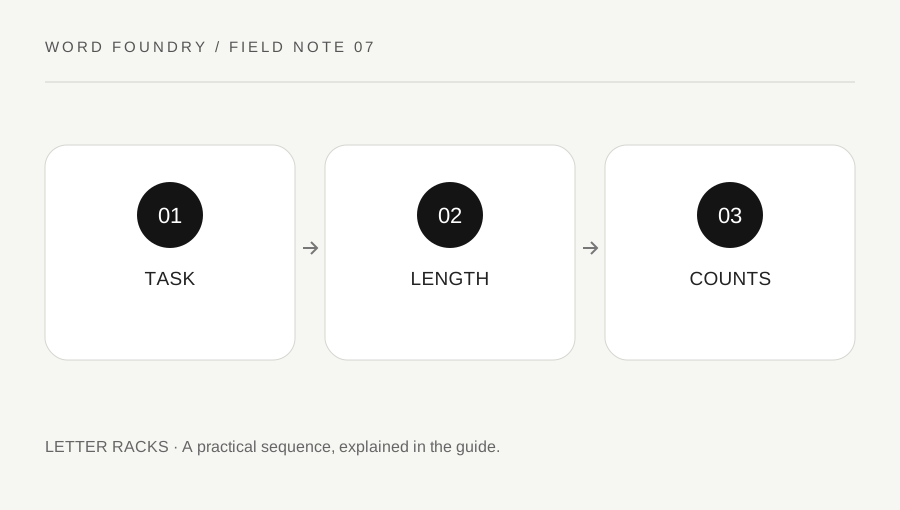
Original explanatory diagram. Numerical examples in this guide illustrate the reasoning; they are not a claim of hands-on testing.
Write the resource rule
A full anagram rearranges the complete letter inventory without adding or dropping a copy. A subset word uses only some available resources. If the rack contains seven letters, a four-letter result can satisfy a subset task but cannot be its full anagram. This is a rule difference, not a quality ranking between the words.
Read the exercise instructions carefully. Some tasks permit a wildcard, some require a minimum length and some supply letters outside the rack through a separate grid. Our helper knows only the rack and filters you enter. It does not infer those additional rules or inspect an external board.
Use exact length for a full-rack check
Count all supplied letters and wildcard resources. Set the helper's exact-length filter to that total when you want full-rack candidates. The frequency check then ensures that repeated letters fit as well. A candidate with the correct length can still fail if it needs an unavailable letter copy.
For the rack LISTEN, a six-letter search can include LISTEN and SILENT in our practice vocabulary after the example entries are included. A shorter result such as LINE uses a subset and should disappear under the exact-length filter. The clue, if present, must still distinguish which full anagram the exercise intends.
Check repeated letters and blanks
For BALLOON, the complete inventory includes two Ls and two Os. A full anagram cannot trade one of those copies for another letter merely to form a familiar word. In rack mode each question mark supplies one missing occurrence, but it still counts as one total resource.
If your task requires using all resources, a wildcard may stand for a letter already present or a different letter, subject to the actual rules. Verify the final candidate's entire inventory. The helper's result says only that the candidate can be built from the input under its simple model; it does not certify a competition's acceptance rules.
Review the answer against meaning
A full anagram can be perfectly spelled and still fail a clue. LISTEN and SILENT share letters, but a clue about paying attention points toward one sense, while a clue about making no sound points toward another. Check the intended part of speech and meaning after the inventory check.
For practice, write two fresh clues for a verified anagram pair and ask someone to explain which clue fits which word. Do not claim the pair exhausts every possible English arrangement. Our curated vocabulary is limited, so broader uniqueness requires a suitable reference. Keeping length, counts and meaning as separate stages makes the reasoning easy to inspect.
Audit an answer with a resource table
For an independent check, make six boxes for LISTEN and cross off one box for each letter in SILENT. Every box is used exactly once, so the full inventory is preserved. Now try LINE: its letters can be crossed off, but two resources remain. It is a valid subset under the simple model and not a full-rack solution.
Repeat with a repeated-letter rack such as LETTER. List E twice and T twice instead of writing only the distinct types. Ask the learner to explain why a trial with three Es fails without an appropriate wildcard. Keep the exact-length setting in the exercise record. This check distinguishes resource use from the separate question of whether a candidate is in the chosen dictionary or fits a clue.
A practical checklist
Tick items for your own use. This checklist is saved only in this browser.
Questions that come up
Why does rack mode show shorter words?
Its default task is finding words made from some or all available letters. Set exact length to the rack size when the exercise requires a full anagram.
Does correct length guarantee a full anagram?
No. Per-letter frequencies must also fit. A seven-letter candidate can still require a repeated letter the rack does not supply.
Can two answers use the same full rack?
Yes. Anagrams can share the full inventory. Use the clue and external rules to choose, and remember that a limited practice list does not prove exhaustive uniqueness.
References & scope
Background references checked on 18 October 2026. The examples and practice exercises are original editorial explanations, not copied procedures or professional advice.
- Cambridge Dictionary: word formation
- Merriam-Webster: dictionary lookup
- Merriam-Webster: official game dictionary lookup
- Cambridge: compounds and written forms
- Cambridge: colour and color usage labels
- Merriam-Webster: homophone terminology
- Merriam-Webster: palindrome terminology
- Merriam-Webster: thesaurus sense grouping