Combine Word Filters as an Intersection, Not Extra Letters
Length, starting letters and ending letters narrow a candidate set together. They do not donate letters to a rack. A clear filtering sequence helps you understand why a word remains or disappears without repeatedly changing the whole input.
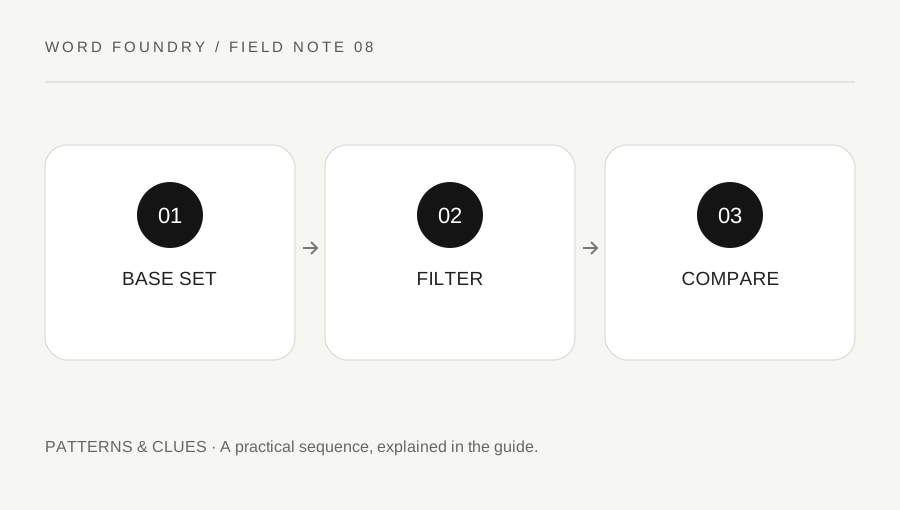
Original explanatory diagram. Numerical examples in this guide illustrate the reasoning; they are not a claim of hands-on testing.
Start with one search model
Choose pattern mode when positions are fixed and rack mode when the letters can be rearranged. Enter only the information that belongs to that model. A pattern's question mark is an unknown position; a rack's question mark is one available wildcard resource. Read the selected mode before adding any other filter.
Run the simplest search first and note the total count. This creates a baseline. If you enter every filter at once and get no results, it is harder to identify which condition created the conflict. A narrow deliberate sequence produces evidence about the input rather than a series of unexplained guesses.
Add length with a clear purpose
An exact-length filter selects candidates of that size. In pattern mode it must agree with the number of positions. In rack mode it can request a shorter subset or a full-rack anagram, depending on the chosen number. A length filter never makes an absent letter available.
Consider the rack GARDEN?. A six-letter filter requests six-letter candidates from seven total resources. It does not require using every resource. If a task instead requires all seven, use seven. Keep the purpose of the filter in your notes so a later change does not silently switch the solving task.
Treat starting and ending sequences literally
The starting filter fixes the candidate's first letters in the given order. The ending filter fixes its final letters. In rack mode those letters still consume the available inventory. A required ending containing two copies of a letter needs both copies or sufficient wildcards.
For BALL from BALLOON, a starting B and ending LL are compatible with the counts. From BALON, the same candidate lacks the second L. The prefix and suffix filters cannot repair that shortage. In pattern mode they must also agree with the fixed positions, so a contradictory prefix can correctly remove every result.
Diagnose one conflict at a time
When a result disappears, remove the most recent filter and compare. If candidates return, inspect the meaning of that filter: wrong length, reversed ending letters or a prefix based on an uncertain guess. Preserve confirmed constraints and relax only doubtful ones.
The helper displays a total and at most the first 150 alphabetically. A word not visible in a long displayed list may require narrower filters; a word outside the underlying curated vocabulary will not appear at all. Keep that distinction clear. The tool supports transparent candidate exploration, while dictionary meaning and external acceptance rules remain separate checks.
Walk through a filter intersection
Start with the rack GARDEN? and request five-letter candidates. Add the prefix GR, then the suffix ND. GRAND is buildable: G, R, A, N and D are available, while E and the wildcard need not be used in a subset search. The prefix and suffix did not supply any extra resources.
Now remove the A from the rack while keeping the one wildcard. GRAND can still be buildable because the wildcard covers that single missing A. Remove the wildcard too and the candidate fails. This small comparison isolates the inventory condition from the length and edge filters. Record which input changed at each step rather than editing several controls together. The same method can explain an empty result without treating it as evidence that the spelling is invalid English.
Keep optional fields empty when they are not part of the task. A forgotten ending from a previous search can silently narrow a new rack query.
A practical checklist
Tick items for your own use. This checklist is saved only in this browser.
Questions that come up
Does a required prefix supply its own letters?
No. In rack mode every prefix and suffix letter still consumes the entered resources. The filter narrows candidates; it does not change the inventory.
Why is a pattern length rejected?
A fixed-position pattern already defines its length. The optional exact-length value must agree with the number of pattern positions.
Are all matches visible at once?
The total count is shown, with at most 150 entries displayed alphabetically. Narrow the query to inspect a smaller set. The vocabulary itself remains deliberately limited.
References & scope
Background references checked on 18 October 2026. The examples and practice exercises are original editorial explanations, not copied procedures or professional advice.
- Cambridge Dictionary: word formation
- Merriam-Webster: dictionary lookup
- Merriam-Webster: official game dictionary lookup
- Cambridge: compounds and written forms
- Cambridge: colour and color usage labels
- Merriam-Webster: homophone terminology
- Merriam-Webster: palindrome terminology
- Merriam-Webster: thesaurus sense grouping