Sound-Alike Words: Use Meaning and Spelling to Resolve the Clue
A familiar sound can point toward more than one spelling. When a clue involves a sound-alike relationship, keep pronunciation, meaning and letter positions as separate checks. Accent differences and puzzle conventions can also affect whether the intended relationship feels clear.
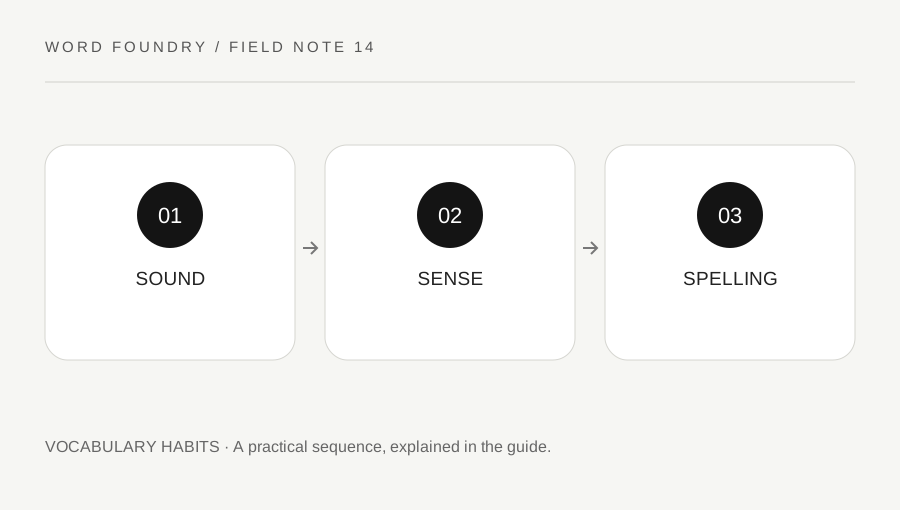
Original explanatory diagram. Numerical examples in this guide illustrate the reasoning; they are not a claim of hands-on testing.
Identify which relationship is suggested
A homophone relationship concerns words pronounced alike under the relevant pronunciation, while their meanings or spellings differ. Do not assume similar-looking words must sound alike, or that identical sounds supply the correct spelling for a clue. Read any indication that the task is about hearing or speech.
Ordinary straightforward clues may simply require a meaning match, not sound-based wordplay. Avoid forcing a homophone explanation into every difficult clue. If you are creating an exercise, state that the task concerns sound-alike words so a beginner does not need to guess the mechanism.
Check the intended sense
Consider FLOUR and FLOWER. A clue about baking powder ground from grain points toward one, while a clue about a bloom points toward the other. Their similar pronunciation does not make them interchangeable in writing. The fixed letter positions and answer length can supply additional confirmation.
Write an original sentence for each word and verify any unfamiliar meaning in a dictionary. Do not copy definitions into your own answer key. A personal sentence makes the distinction concrete and reveals whether you actually understand the sense, rather than merely recognizing the pair as a familiar spelling exercise.
Respect pronunciation variation
A proposed sound-alike pair may work differently across accents. If the exercise depends on a specific pronunciation, make that context clear and consult an appropriate dictionary pronunciation reference. Avoid telling a learner that their ordinary accent is wrong because a puzzle uses another convention.
For private practice, begin with a pair that is clear to the participants and discuss the written meanings. Our helper does not compare audio or decide pronunciation equivalence. It can test spelling patterns and inventories only. A list match therefore cannot establish that two words are homophones in every variety of English.
Return to all the constraints
Once a candidate fits the sound relationship, check the clue's meaning, grammatical role, length and crossings. A sound match alone is insufficient. A five-letter slot and a six-letter slot distinguish FLOUR and FLOWER even before their final letters are considered.
After solving, record which evidence settled the choice. This can be the meaning, the position pattern or an explicit sound indicator. When publishing an original exercise, retain the intended pronunciation context and accepted alternatives. Clear scope makes a small wordplay task fair without pretending that spelling tools can resolve every spoken-language distinction.
Use an original sentence contrast
Write two short original sentences: “We watched the sea from the harbour” and “I can see the distant boat.” Ask the learner which spelling names the water and which expresses perception. Then conceal the target words and use the sentences as separate clues, checking the intended grammar.
Both SEA and SEE have three letters, so length alone will not resolve that pair. A fixed final letter or the sentence meaning can. This contrasts with FLOUR and FLOWER, where lengths differ as well as meanings. Record which evidence is doing the work in each example. Check pronunciation context where needed and avoid claiming that every pair behaves identically in all accents. The exercise remains useful when the explanation distinguishes sound, written form and sense instead of treating one familiar association as a universal rule.
Keep the original sentence beside any shortened clue. Removing context can introduce ambiguity that was absent from the complete sentence, so test the published wording separately.
A practical checklist
Tick items for your own use. This checklist is saved only in this browser.
Questions that come up
Can a pattern helper confirm pronunciation?
No. This helper compares written letters and counts. Use a suitable pronunciation reference and the exercise’s stated context for sound-based relationships.
Are sound-alike words interchangeable in writing?
Not usually. Their meanings and spellings can differ. Use the word whose sense and grammatical role fit the sentence or clue.
What if the pair does not sound alike in my accent?
Check the exercise’s intended pronunciation context. Accent variation can matter, so a fair original exercise should acknowledge the convention rather than treating one pronunciation as universal.
References & scope
Background references checked on 18 October 2026. The examples and practice exercises are original editorial explanations, not copied procedures or professional advice.
- Cambridge Dictionary: word formation
- Merriam-Webster: dictionary lookup
- Merriam-Webster: official game dictionary lookup
- Cambridge: compounds and written forms
- Cambridge: colour and color usage labels
- Merriam-Webster: homophone terminology
- Merriam-Webster: palindrome terminology
- Merriam-Webster: thesaurus sense grouping