Repeated Letters: Check Positions and Counts Separately
Repeated letters introduce two kinds of information: how many copies occur and where those copies sit. A reliable solving method tracks both. Recognizing a familiar spelling shape helps, but it should not override the actual constraints of the exercise.
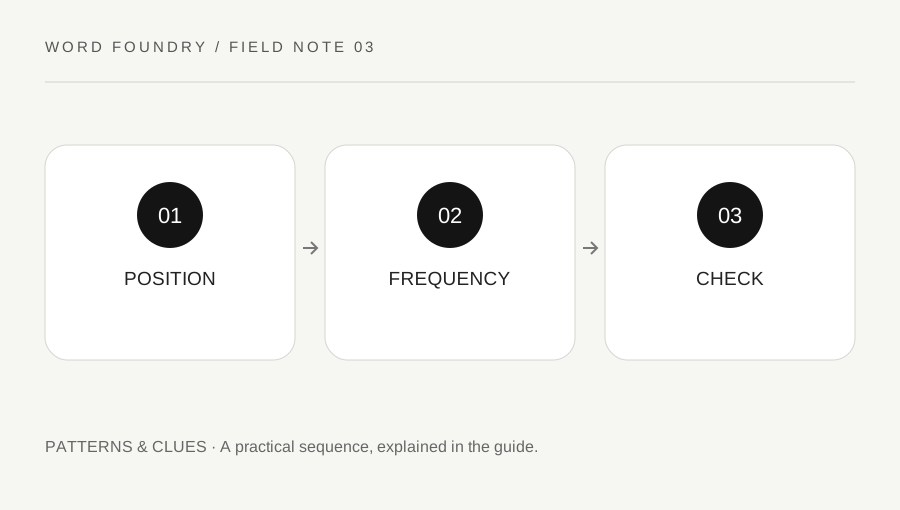
Original explanatory diagram. Numerical examples in this guide illustrate the reasoning; they are not a claim of hands-on testing.
Distinguish a pair from a total count
In LETTER, the two Ts are adjacent, while the two Es occupy separate positions. Saying that a word has repeated letters does not tell you whether any are doubled side by side. Record exact positions when the puzzle supplies them and total frequencies when it supplies a rack.
A pattern such as ?E??E? fixes two Es but says nothing by itself about whether another E could occur in an unknown position. A rack with two Es sets a resource ceiling unless wildcards supply more. Confusing these different constraints can exclude valid candidates or admit impossible ones.
Build a simple comparison table
Write the candidate on one line and number its positions below. Then list each distinct letter with its frequency. For LETTER, the positional line has six places and the count line includes E twice, T twice, L once and R once. Compare that record with the pattern or rack rather than relying on a visual impression.
This is especially useful for longer words and familiar forms you tend to spell automatically. A solver can recognize a word's overall shape while overlooking one repeated consonant. Slowing down for a count check is often more effective than repeatedly rearranging the same letters without a record.
Test a wildcard shortage carefully
Suppose the rack is LETR??. The two supplied wildcards can cover the additional E and T needed for LETTER. LETR? has only five resources and cannot form the six-letter candidate, regardless of how familiar the word looks. Length is the first check; per-letter shortages are the next.
With a position pattern, use question marks to represent unknown positions instead. Each question mark belongs to one fixed slot, but it does not impose a global limit on a letter. Our helper separates these modes so that a wildcard's meaning is visible. Read the selected mode before interpreting any result.
Learn spelling without inventing rules
Group a few personally difficult words by their actual spelling feature: adjacent consonants, repeated vowels or a suffix that changes the base form. Write an original sentence for each and check it in a reliable dictionary. Do not infer a universal spelling rule from one small group; English word histories and formations can produce many exceptions.
For a brief exercise, compare LETTER, BETTER and LITTLE. Note what is genuinely shared and what is not. The point is to notice specific forms accurately, not to claim that every similar-sounding word uses the same consonant pattern. Keep uncertain observations labelled as examples until a reference supports a broader rule.
Use the helper as a second check
Try writing the candidate and its inventory yourself before searching. If the helper disagrees, compare the input mode, length and repeated-letter counts. If the word is absent from the practice list, use a dictionary rather than treating the missing result as a spelling verdict.
After correcting a mistake, note the precise cause: one missing consonant, an uncertain position or a mistaken wildcard assumption. This produces a useful practice target for the next session. A collection of accurately checked examples is more valuable than a long list of words copied without understanding the repeated-letter structure.
A practical checklist
Tick items for your own use. This checklist is saved only in this browser.
Questions that come up
Does a pattern with two Es forbid a third E?
Not unless another rule says so. Fixed Es show known positions; unknown positions may also contain E. A rack inventory, by contrast, limits the available copies unless wildcards cover the shortage.
Why does a familiar word fail a rack search?
Count its total letters and every repeated occurrence. You may be missing one copy even though all the distinct letter types are present. Also remember that the practice vocabulary is not exhaustive.
Can I learn spelling from letter shape alone?
Shape is a useful clue but should be checked against exact letters and a reliable reference. Record specific difficult forms and use them in your own sentences rather than relying on visual familiarity alone.
References & scope
Background references checked on 18 October 2026. The examples and practice exercises are original editorial explanations, not copied procedures or professional advice.
- Cambridge Dictionary: word formation
- Merriam-Webster: dictionary lookup
- Merriam-Webster: official game dictionary lookup
- Cambridge: compounds and written forms
- Cambridge: colour and color usage labels
- Merriam-Webster: homophone terminology
- Merriam-Webster: palindrome terminology
- Merriam-Webster: thesaurus sense grouping