Word Endings and Families: Make Better Candidates, Then Verify Them
Recognizing a familiar ending can help you form candidates, but attaching an ending does not automatically create an accepted word. Use word families to organize practice, then check spelling, meaning and the rules of the particular exercise.
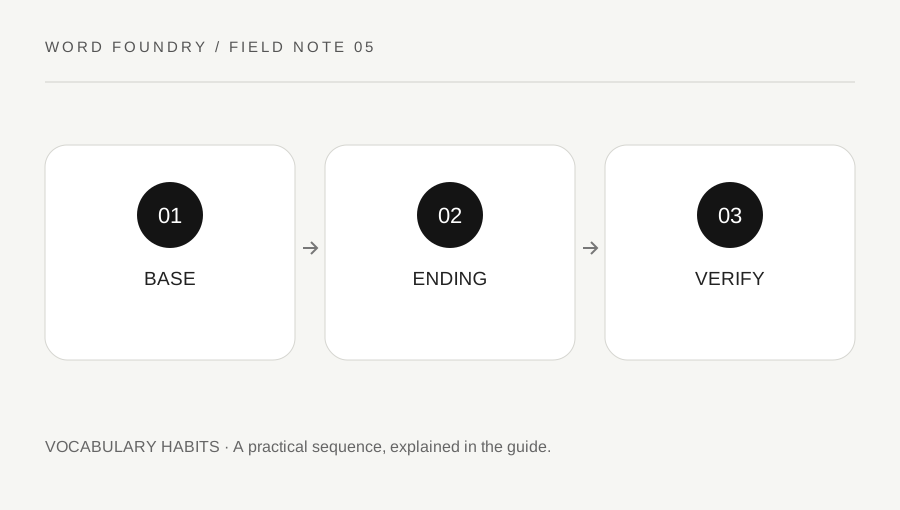
Original explanatory diagram. Numerical examples in this guide illustrate the reasoning; they are not a claim of hands-on testing.
Start from a word you can explain
Choose a familiar base and write a short sentence that shows its meaning. Then look for related forms in a reliable dictionary. Related words can change grammatical role as well as spelling. A noun, verb and adjective from one family may not fit the same clue even when their letters appear promising.
Do not rely on sound alone to identify a family. Similar endings can occur in unrelated words, and a recognizable sequence may be part of the base rather than a productive suffix. Treat the ending as a useful observation until you have checked the actual form and use.
Compare meaning and grammatical role
If a clue appears to ask for a person who performs an action, a familiar person-forming ending may suggest candidates. But not every verb forms an ordinary noun by the same process, and some related words have specialized meanings. Verify a candidate rather than constructing an unfamiliar form and assuming it must exist.
Cambridge's word-formation reference distinguishes processes such as prefixes, suffixes and compounds. That framework can organize your notes. Our examples and exercises are original; they are not a substitute for the reference or a complete account of English morphology. Keep the practice tied to words you can use accurately.
Check what happens to spelling
Adding an ending can coincide with a spelling change, so count the final letters rather than simply appending a visual chunk to the base. Check doubled consonants, omitted final letters and changed vowel sequences against an actual dictionary entry. Avoid turning one example into an exceptionless rule.
For a personal practice set, compare PLAY, PLAYER and PLAYFUL, then write a different sentence for each. Note the shared letters and the different roles in your sentences. Next choose another family from your reading and verify it independently. The goal is accurate comparison, not automatic generation of every possible-looking ending.
Apply family knowledge to a pattern
Return to the fixed positions in the puzzle. A plausible ending is useful only if it fits those positions and the answer length. With a rack, the ending also consumes its actual letters; it cannot be added for free. Check the remaining inventory after reserving it.
If a candidate fits the spelling but not the clue's tense or grammatical role, keep searching. Conversely, a strong meaning match with one conflicting crossing deserves a check of that crossing. Use the helper to narrow possibilities, then return to the full problem. The practice vocabulary is limited, so dictionary verification remains important for less familiar forms.
Build a small, useful reference notebook
Keep a few word families with original sentences, exact spellings and the source you used to verify uncertain forms. Include a note about the mistake that prompted the entry. This makes the notebook practical: you can revisit the distinction instead of rereading a long unstructured list.
When a commercial puzzle or competition is involved, check its accepted lexicon separately. A dictionary word, a common inflection and an allowed competition entry are related but different questions. Word Foundry does not claim official acceptance. Its helper and exercises support transparent exploration while leaving those external rules visible.
When revisiting a note, cover the related forms and reconstruct them from your own example sentences. Then compare the exact spellings again.
A practical checklist
Tick items for your own use. This checklist is saved only in this browser.
Questions that come up
Can I add a familiar suffix to any word?
No. Productive-looking endings do not guarantee an established or appropriate form. Check the actual entry, spelling and meaning, especially when the result is unfamiliar or the clue requires a specific grammatical role.
Why does a related word not fit the clue?
Word families can contain different parts of speech and meanings. Compare the clue’s grammar and sense, not only the shared letters. A noun and an adjective are not interchangeable answers.
Does the helper contain every inflection?
No. Its curated vocabulary is intentionally limited. Use an appropriate dictionary for broader language verification and the relevant official lexicon when a particular game’s acceptance rules matter.
References & scope
Background references checked on 18 October 2026. The examples and practice exercises are original editorial explanations, not copied procedures or professional advice.
- Cambridge Dictionary: word formation
- Merriam-Webster: dictionary lookup
- Merriam-Webster: official game dictionary lookup
- Cambridge: compounds and written forms
- Cambridge: colour and color usage labels
- Merriam-Webster: homophone terminology
- Merriam-Webster: palindrome terminology
- Merriam-Webster: thesaurus sense grouping