Compound Words: Check Spaces and Hyphens Before Counting Letters
Related expressions can appear as one word, separate words or hyphenated forms. A puzzle may represent those characters differently from a dictionary entry. Verify the written form and the puzzle’s convention before stripping spaces or counting answer positions.
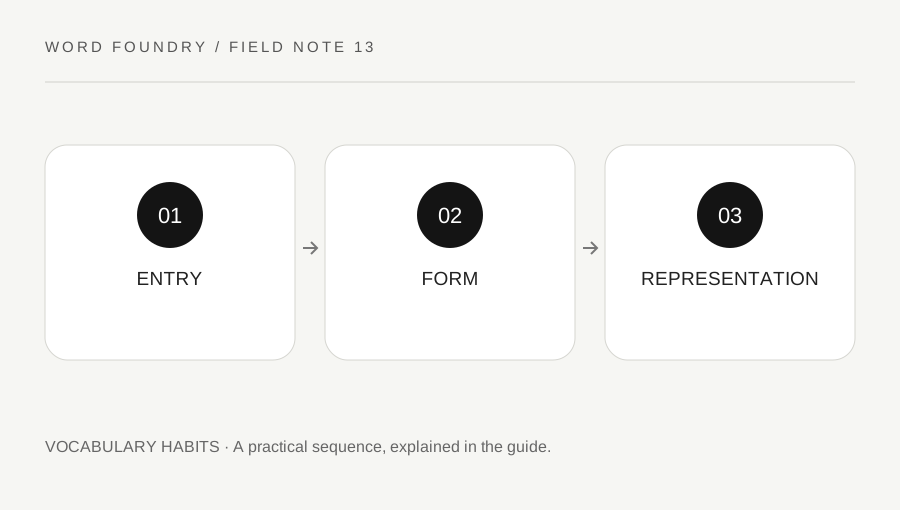
Original explanatory diagram. Numerical examples in this guide illustrate the reasoning; they are not a claim of hands-on testing.
Find the actual dictionary form
Look up the complete expression in a suitable dictionary. Check whether the intended sense is written closed, open or hyphenated, and whether variants are listed. Do not assume two familiar words can always be joined without a space. The spelling of a compound can be conventional and can vary with context or reference.
Read the part of speech and example context to identify the intended sense. A similar sequence used as a noun and as a modifier may follow different conventions. Use an original sentence to test meaning instead of copying the dictionary's definition or example into your own published exercise.
Count the representation the task uses
A letter-only grid can omit spaces or punctuation while a written answer retains them. The puzzle instructions should explain this. An enumeration may show separate word lengths or a hyphenated form; follow that notation rather than imposing our helper's simple single-string model.
Our input accepts English letters and question marks, without spaces or hyphens. That boundary is a technical simplification, not a declaration that open or hyphenated compounds are invalid English. If you remove punctuation for a private pattern experiment, keep the original form beside it and state the transformation.
Use a clear teaching comparison
Compare SUNFLOWER, ICE CREAM and MOTHER-IN-LAW as familiar examples of different written forms. Count letters separately from spaces and hyphens, then record how a particular exercise would represent them. The total number of characters in typed text is not always the number of letter squares in a grid.
Do not infer that every compound with the same meaning pattern uses the same spelling style. Verify the actual expression. A clue can strongly suggest a concept while its expected written form remains uncertain. Dictionary checking and the puzzle's enumeration together provide a better basis than guessing from the visual length of a phrase.
Publish practice with explicit conventions
When creating an original exercise, state whether answers can contain multiple words and how spaces or hyphens are shown. Choose an answer whose intended form you can verify. Test the clue with another person and accept that a recognized variant may require a clear policy rather than an unexplained rejection.
Our curated vocabulary does not aim to include all compounds or spelling variants. Use the helper for the limited letter model it describes, then return to the actual reference form. A transparent representation rule prevents a solver from mistaking a formatting limitation for a language rule and makes your own answer checks easier to reproduce.
Count characters and letters separately
Make a small table for SUNFLOWER, ICE CREAM and MOTHER-IN-LAW. SUNFLOWER contains nine letters with no internal separator. ICE CREAM contains eight letters plus one space. MOTHER-IN-LAW contains eleven letters plus two hyphens. Check the counts directly rather than estimating from the printed width.
If an original grid omits separators, state that rule and preserve the dictionary form in the answer key. A normalized letter string is a representation for that exercise, not a proposed new spelling. Ask a tester to reconstruct the written answer from the grid and its enumeration. If they cannot tell where the words divide, provide clearer notation. This small audit prevents a correct concept from being rejected because the author confused typed character count with the number of letter positions supplied to the solver.
A practical checklist
Tick items for your own use. This checklist is saved only in this browser.
Questions that come up
Does the helper’s rejection mean a compound is invalid?
No. The input model excludes spaces and punctuation for simplicity. Language validity and the exercise’s representation rules need separate dictionary and instruction checks.
Can I join any two words into one?
No. Verify the conventional written form and intended sense. Compounds can be closed, open or hyphenated, with variants depending on context and reference.
What should an original exercise state?
Explain whether multiword answers are allowed and how spaces or hyphens are represented. Keep the verified answer form and any accepted variants with the answer key.
References & scope
Background references checked on 18 October 2026. The examples and practice exercises are original editorial explanations, not copied procedures or professional advice.
- Cambridge Dictionary: word formation
- Merriam-Webster: dictionary lookup
- Merriam-Webster: official game dictionary lookup
- Cambridge: compounds and written forms
- Cambridge: colour and color usage labels
- Merriam-Webster: homophone terminology
- Merriam-Webster: palindrome terminology
- Merriam-Webster: thesaurus sense grouping