Letter-Rack Searches: Count Copies, Not Just Letter Types
A letter rack describes how many copies of each letter are available. A word can use a letter twice only when the rack supplies both copies or a wildcard can replace the missing copy. Frequency counts prevent many misleading suggestions.
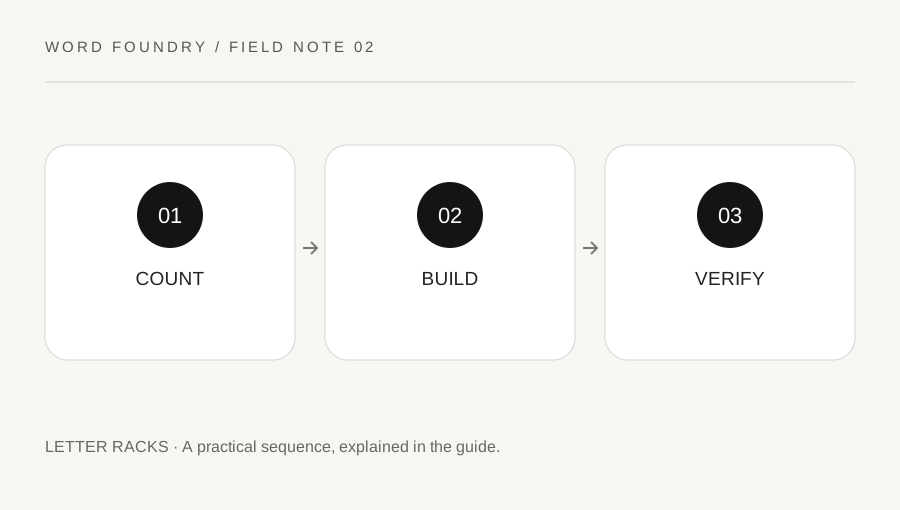
Original explanatory diagram. Numerical examples in this guide illustrate the reasoning; they are not a claim of hands-on testing.
Turn the rack into a small inventory
Write the rack in any order, then count repeated letters. For BALLOON, the inventory contains one B, one A, two Ls, two Os and one N. Order does not matter in rack mode. This is different from a pattern, where each position is fixed. Keeping the two modes distinct makes the output much easier to interpret.
Our rack helper finds words that can be built from some or all of the supplied letters. It does not require every tile to be used. A candidate cannot be longer than the available letter and wildcard count. If your own puzzle requires using the complete rack, set the exact length to the rack length.
Treat duplicate demand explicitly
Suppose a candidate needs two Ls. A rack with one L does not satisfy it merely because L appears somewhere in the input. Compare the candidate's counts with the rack's counts for every letter. Any shortage must be supplied by an available wildcard; otherwise the candidate is excluded.
For BALLOON, BALL can be formed while BALLOON itself uses every letter. A rack such as BALON lacks one L and one O for the longer word. This is a useful handwritten check whenever a suggestion looks suspicious. It also explains why searching an unordered set of unique letters is not sufficient for a genuine rack tool.
Use a wildcard as one resource
In this tool a question mark in the rack represents one unknown letter. Each wildcard can cover one missing occurrence, and it is consumed only once. A rack with one wildcard cannot repair shortages in two different positions. The helper adds all candidate shortages before comparing them with the number of wildcards.
For example, BALON?? can supply the missing L and O needed for BALLOON. BALON? cannot. A wildcard does not waive the length limit or make an arbitrary number of repeated letters available. The displayed candidates still come only from the curated practice vocabulary, so an absence is not an official validity judgment.
Add constraints after the basic check
Start with the rack alone to see the vocabulary it supports. Then add an exact length or a required starting or ending sequence if your exercise calls for one. A prefix constraint fixes the start of the candidate; it does not add letters to the rack. Those letters still have to be available in the inventory.
Work through one change at a time. If a rack search returns candidates but adding an ending removes them all, inspect whether that ending uses repeated letters you no longer have. Do not change the rack merely to obtain a preferred word unless your exercise explicitly permits an exchange or a different source of letters.
Verify rules outside this practice tool
Different games and puzzles allow different dictionaries, abbreviations, inflections and board interactions. A rack-only helper does not know about adjacent board letters, premium squares, scoring or a particular competition's lexicon. Verify those conditions under the actual rules. We do not assign scores or certify official acceptance.
For learning, choose one candidate and write the letter inventory that supports it. Then remove a repeated letter and see which candidates disappear. This exercise is useful even without playing a commercial game: it develops attention to spelling structure and resource counts, while the tool's limited vocabulary keeps the result set manageable.
A practical checklist
Tick items for your own use. This checklist is saved only in this browser.
Questions that come up
Must a result use every rack letter?
No. Results may use some or all letters. Set the exact length to the rack’s total size when you want full-rack anagrams, then apply any additional rules from your exercise.
Does a wildcard count more than once?
No. Each ? covers one missing letter occurrence. The helper totals shortages across the entire candidate, so one wildcard cannot cover both a missing L and a missing O.
Why are scores not displayed?
The tool is a vocabulary and letter-count practice helper. Scores depend on a specific game’s rules, board and accepted lexicon, which are outside this site’s stated scope.
References & scope
Background references checked on 18 October 2026. The examples and practice exercises are original editorial explanations, not copied procedures or professional advice.
- Cambridge Dictionary: word formation
- Merriam-Webster: dictionary lookup
- Merriam-Webster: official game dictionary lookup
- Cambridge: compounds and written forms
- Cambridge: colour and color usage labels
- Merriam-Webster: homophone terminology
- Merriam-Webster: palindrome terminology
- Merriam-Webster: thesaurus sense grouping