Names and Abbreviations: Read the Puzzle’s Vocabulary Policy
A sequence can be a familiar name or abbreviation without being allowed in a particular word exercise. Acceptance is a rule question. Identify the category and the puzzle’s policy before treating a plausible pattern match as a permitted answer.
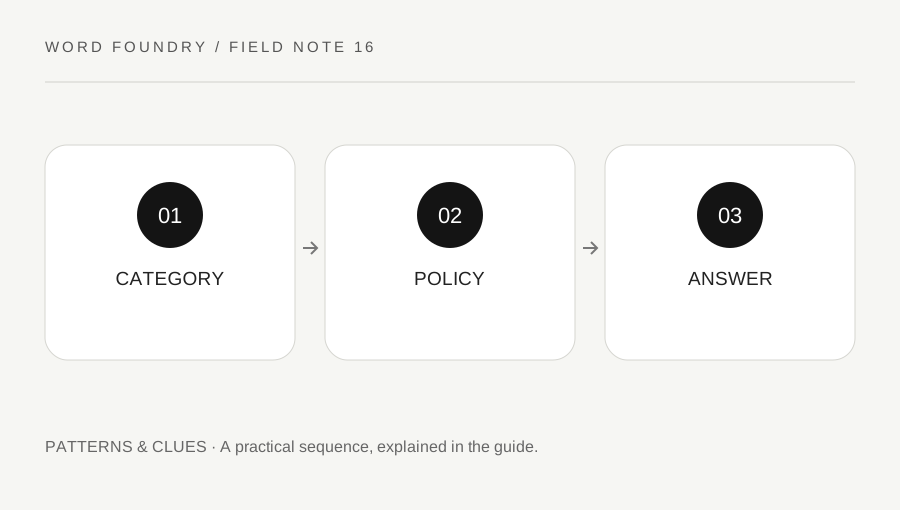
Original explanatory diagram. Numerical examples in this guide illustrate the reasoning; they are not a claim of hands-on testing.
Separate ordinary words from labels
A proper name identifies a particular person, place or entity, while an abbreviation represents a shortened form under its own convention. Some sequences also have ordinary dictionary senses. The same letters can therefore need different treatment depending on the intended meaning.
Read the actual clue and context. Capitalization in a grid may be uniform for visual reasons and cannot always reveal whether the answer is a proper name. Do not infer a puzzle's entire vocabulary policy from one answer. Find its instructions or accepted reference, especially in a competitive setting.
Check the permitted categories
An original practice exercise should state whether it allows proper names, initials, abbreviations, inflections and multiword expressions. A published puzzle may use some of these categories deliberately. A game lexicon can have a different policy again. No universal word-validity rule settles all those settings.
Our helper is a curated plain-word practice list and is not an official acceptance checker. A missing name does not prove the clue is wrong, and an included letter sequence does not certify that its name sense is permitted. Verify both the actual sense and the governing policy.
Work through a category conflict
Imagine a five-letter pattern with a clue naming a specific city, while the exercise instructions say ordinary common words only. Before searching more aggressively, check whether the clue or the instructions were copied correctly. A name that fits the letters would still conflict with that stated policy.
In another exercise, names may be explicitly allowed and the same category becomes appropriate. The difference comes from the rules, not the visual pattern. When making your own exercise, choose examples that match the stated scope and keep a note explaining any unusual category so a reviewer can assess it fairly.
Explain decisions without overstating them
A useful answer distinguishes “not in this practice list,” “not permitted by this puzzle's rules” and “not verified in the consulted reference.” These are different claims. Avoid labeling an unfamiliar sequence nonsense when it may be a name, specialist term or abbreviation outside the tool's scope.
If a dispute remains, consult the designated reference or organizer. Keep the original clue, proposed answer and exact rule with the question. That record is more useful than an isolated screenshot of a zero-result search. Transparent category policies make both original practice and outside-puzzle assistance easier to use responsibly.
Compare a shared spelling with different roles
Use MARCH in two original contexts: “March begins after February” and “The group will march along the path.” One refers to a named month and the other to an action. Uniform uppercase letters in a grid would conceal that capitalization distinction, so meaning and policy must do the work.
Ask which sense a clue requests and whether that category is allowed. A helper entry for the letter sequence cannot make that decision. In your answer key, record the intended sense and the relevant rule, not only the spelling. If another category is excluded, say so clearly. This exercise shows why a familiar sequence can be appropriate in one setting and inappropriate in another without either side needing to claim that the letters are not a real word at all.
When asking an organizer about a disputed entry, include the exact clue, proposed sense and relevant rule wording. A bare uppercase string can conceal the category distinction that caused the disagreement.
A practical checklist
Tick items for your own use. This checklist is saved only in this browser.
Questions that come up
Does an included word prove every sense is allowed?
No. A sequence can have several senses or categories. The actual clue and governing rules determine whether the intended use is acceptable.
Why are names missing from the helper?
The list is deliberately limited and focused on plain-word practice. It is not a comprehensive proper-name database or an official game lexicon.
Who settles a competition dispute?
Use the competition’s designated reference and organizer process. This site’s limited result list cannot replace those rules.
References & scope
Background references checked on 18 October 2026. The examples and practice exercises are original editorial explanations, not copied procedures or professional advice.
- Cambridge Dictionary: word formation
- Merriam-Webster: dictionary lookup
- Merriam-Webster: official game dictionary lookup
- Cambridge: compounds and written forms
- Cambridge: colour and color usage labels
- Merriam-Webster: homophone terminology
- Merriam-Webster: palindrome terminology
- Merriam-Webster: thesaurus sense grouping