A Synonym Suggestion Still Needs the Right Sense and Grammar
Related words are useful candidates, but they are not interchangeable in every sentence. A clue can depend on a specific sense, grammatical role or tone. Use a thesaurus to explore possibilities, then test each candidate against the whole task.
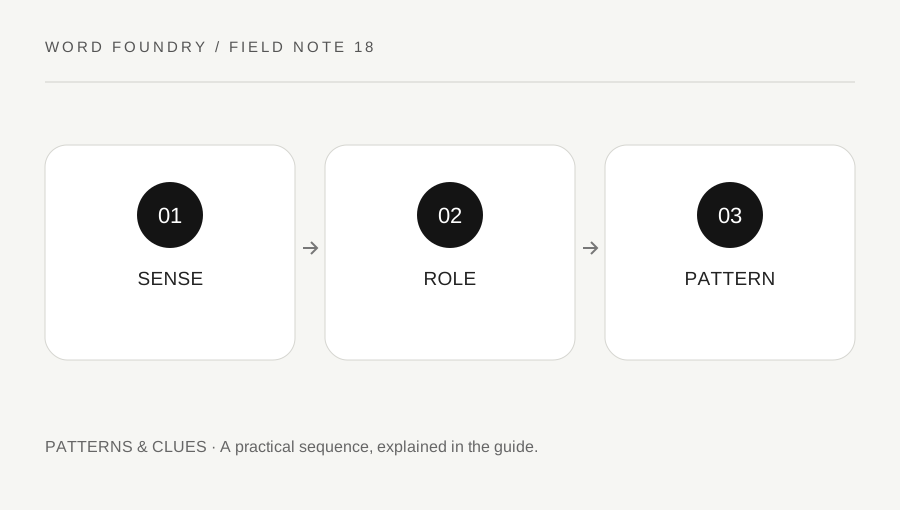
Original explanatory diagram. Numerical examples in this guide illustrate the reasoning; they are not a claim of hands-on testing.
Paraphrase the clue first
Write a short plain description of what the clue appears to request. Identify whether it wants an action, object, quality or another role. This reduces the chance of browsing a broad synonym list under the wrong sense. A familiar word in the clue may have a less familiar meaning in context.
Keep the paraphrase provisional. A crossing letter or a puzzle convention can reveal that the first interpretation was wrong. The point is to make the assumption visible, not to lock it in. Record alternative senses separately rather than mixing every related word into one unstructured candidate list.
Use the thesaurus grouping carefully
A reputable thesaurus can group synonyms and related terms by shared meaning. Read the relevant sense group and any distinctions, not only the first bold suggestion. A near synonym may overlap in one context while differing in emphasis or grammar elsewhere.
For example, a clue using BRIGHT might concern light, intelligence or a vivid colour. A candidate suitable for one sense may fail another. Verify the proposed meaning in a dictionary when needed. Do not assume the tool's pattern match can choose the intended sense for you.
Test a sentence and the slot
Put the candidate into an original sentence using the intended sense. Check agreement, tense and ordinary usage. Then compare the exact length and fixed positions. A strong meaning match that is one letter too long still fails a fixed-length slot unless the puzzle explicitly uses another representation.
Our helper can explore written candidates but does not provide a semantic ranking. Alphabetical order is not a recommendation that the first result best fits the clue. Read each plausible candidate back into the original task and verify crossings before committing to it.
Explain the final distinction
After solving, note which sense and grammatical role made the answer work. If another candidate was close, explain the specific difference rather than saying it was simply wrong. This makes the exercise useful for vocabulary practice and helps reveal an ambiguous original clue.
When creating a clue, test it with another reader and revise wording that admits several equally fitting answers under the supplied pattern. Do not claim uniqueness from a limited vocabulary search. A clear meaning, appropriate grammar and transparent letter constraints together produce a fairer exercise than a list of loosely related words.
Contrast two senses before searching
Write two original prompts using BRIGHT: one about a room receiving much light and one about an alert, quick-learning student. List a few candidate descriptions for each and verify uncertain words. Do not merge the lists simply because they share the same original adjective.
Choose a fixed length and pattern only after identifying the intended sense. If the constraints eliminate every candidate, revisit both the pattern and the interpretation, keeping confirmed evidence separate from guesses. Ask a reviewer whether another sense fits the clue equally well. This comparison makes ambiguity visible before a solver is blamed for choosing a reasonable alternative. A thesaurus is useful for exploring the semantic neighborhood, while a dictionary and an original sentence help test actual use. None of those checks can waive the supplied letter positions.
Keep rejected candidates with a brief concrete reason when useful: wrong sense, wrong part of speech or wrong length. This is more instructive than an undifferentiated list of incorrect guesses.
A practical checklist
Tick items for your own use. This checklist is saved only in this browser.
Questions that come up
Are all thesaurus suggestions interchangeable?
No. They can differ in sense, grammar, tone or ordinary usage. Read the grouping and test the candidate in context.
Does alphabetical order rank clue fit?
No. The helper lists written matches alphabetically. It does not evaluate meanings or recommend the first result as the best answer.
What if two candidates fit equally well?
Recheck the clue, crossings and representation rules. For an original exercise, revise the wording or accept a clearly justified alternative rather than claiming unsupported uniqueness.
References & scope
Background references checked on 18 October 2026. The examples and practice exercises are original editorial explanations, not copied procedures or professional advice.
- Cambridge Dictionary: word formation
- Merriam-Webster: dictionary lookup
- Merriam-Webster: official game dictionary lookup
- Cambridge: compounds and written forms
- Cambridge: colour and color usage labels
- Merriam-Webster: homophone terminology
- Merriam-Webster: palindrome terminology
- Merriam-Webster: thesaurus sense grouping