No Word Matches? Check Constraints Before Assuming the Word Does Not Exist
An empty result can come from an input conflict or a limited vocabulary. It is not an exhaustive verdict on English. Use a short diagnostic sequence to distinguish a misplaced letter, a count shortage and a missing practice-list entry.
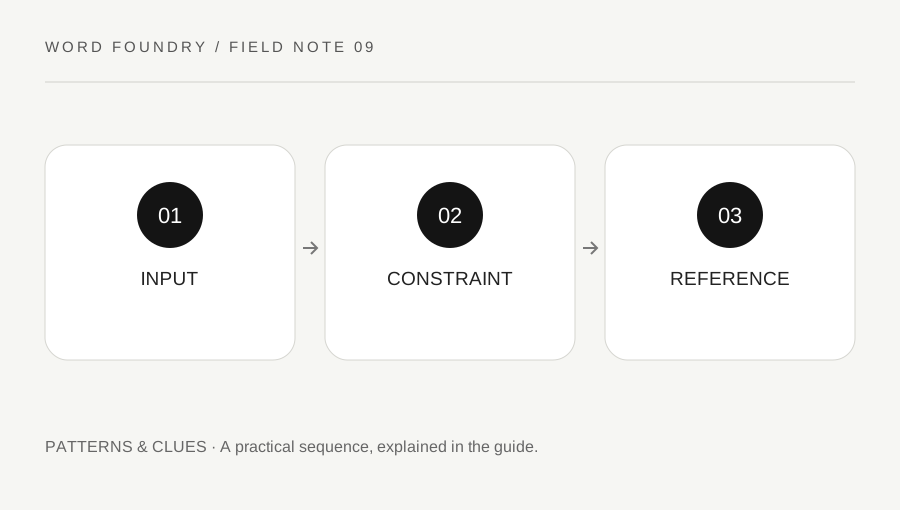
Original explanatory diagram. Numerical examples in this guide illustrate the reasoning; they are not a claim of hands-on testing.
Read the active mode and input
Check whether you selected fixed-position pattern or available rack. A string that is meaningful in one mode can describe a very different task in the other. In pattern mode GARDEN fixes all six positions; in rack mode it permits rearrangement and subsets. A question mark also has a mode-specific meaning.
Inspect the characters. This helper accepts English letters and question marks in the main entry, with letters only in prefix and suffix filters. Spaces, hyphens, accents and punctuation are outside its simple model. An input validation error is different from a valid search returning zero candidates; read the message before changing the query.
Check length and letter copies
Count the pattern positions or rack resources and compare the exact-length filter. In rack mode, inspect repeated-letter demand. A candidate can contain every distinct letter in the input and still require an extra copy. One wildcard covers one missing occurrence, not every shortage at once.
For LETTER, a rack with only one E and one T needs two wildcards to supply the missing copies. A full six-letter candidate cannot come from five total resources. These checks are mechanical and can be verified on paper. They should happen before searching for a complicated linguistic explanation.
Relax only uncertain information
Remove the newest optional filter or replace one doubtful pattern letter with a question mark. Search again and compare the change. If several letters are uncertain, label them in your own notes and test them one at a time. Removing all constraints produces a larger list but little diagnosis.
Suppose a six-letter clue suggests GARDEN but an uncertain crossing gives ?A?D?M. Replacing only the final doubtful M with ? can reveal the candidate. That does not prove the crossing is wrong; return to the crossing clue and verify it. A tool suggestion is a hypothesis to test, not permission to overwrite confirmed evidence.
Recognize vocabulary boundaries
Our practice vocabulary is curated and intentionally incomplete. It omits many specialist terms, names, variants and inflections. If a well-formed query still returns nothing, check the candidate in an appropriate dictionary and the actual puzzle's accepted lexicon. Do not keep distorting a correct spelling merely to make it appear in this list.
Record what caused the empty result: an input typo, incompatible filter, repeated-letter shortage or absent vocabulary entry. That note makes the next search more efficient. The useful outcome can be a clear explanation of the tool's limit, while the broader language question is resolved with a reference designed for that purpose.
Keep a short diagnostic record
Create four columns in your own notes: original input, changed constraint, result and explanation. For a pattern, test a known word with one deliberate wrong fixed letter, then relax only that position. For a rack, remove one repeated copy from LETTER and compare the result before and after adding a wildcard.
Use these controlled examples to learn the tool's behavior before investigating an unfamiliar clue. Include one verified word outside the practice vocabulary if you encounter one naturally, and mark the absence as a vocabulary limit. Do not invent a misspelling to make the test fail. The record should show which claim has actually been tested: input validity, constraint compatibility or dictionary coverage. A clear diagnostic sequence is more useful than dozens of unrecorded searches that all end with zero matches.
A practical checklist
Tick items for your own use. This checklist is saved only in this browser.
Questions that come up
Does zero matches mean no English word exists?
No. It means the limited practice vocabulary has no candidate satisfying the entered constraints. A broader dictionary or the relevant official lexicon may contain the word.
Should I change all uncertain letters at once?
One-at-a-time changes are easier to interpret. Keep confirmed evidence intact and compare how each doubtful constraint affects the result.
Why are hyphenated entries rejected?
The current helper uses a simple English-letter model without spaces or punctuation. Check the actual dictionary form and puzzle representation outside the tool rather than stripping punctuation without explanation.
References & scope
Background references checked on 18 October 2026. The examples and practice exercises are original editorial explanations, not copied procedures or professional advice.
- Cambridge Dictionary: word formation
- Merriam-Webster: dictionary lookup
- Merriam-Webster: official game dictionary lookup
- Cambridge: compounds and written forms
- Cambridge: colour and color usage labels
- Merriam-Webster: homophone terminology
- Merriam-Webster: palindrome terminology
- Merriam-Webster: thesaurus sense grouping