Make an Odd-One-Out Word Exercise with an Explainable Rule
An odd-one-out task is fair when the grouping rule can be explained and reasonable alternatives are considered. Familiar words can belong to several categories at once. Write the intended rule and test it before deciding that one answer is uniquely correct.
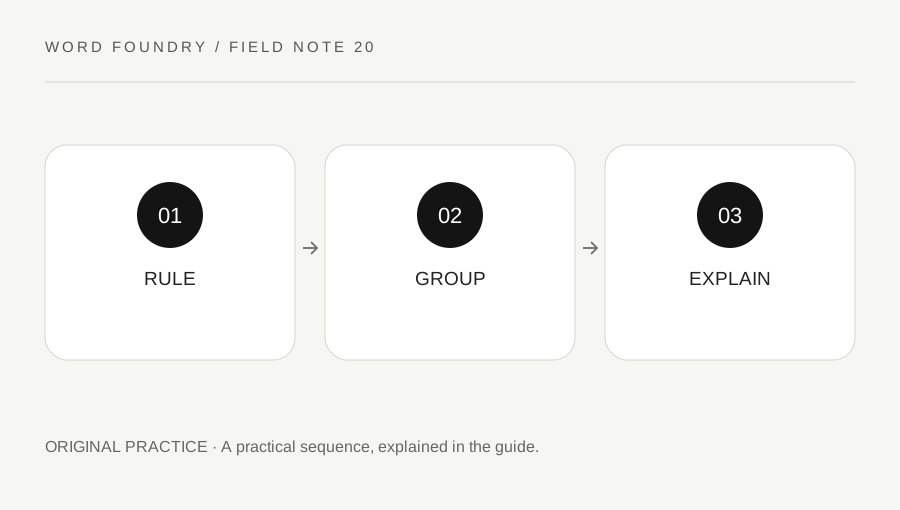
Original explanatory diagram. Numerical examples in this guide illustrate the reasoning; they are not a claim of hands-on testing.
Choose one visible dimension
Decide whether the exercise concerns meaning, spelling, grammatical role or another clearly stated feature. Mixing several hidden dimensions can make a beginner task feel arbitrary. A set of three category members and one exception is easiest to explain when the rule is consistent and the vocabulary is familiar.
Keep the answer key with a short reason, not only the selected word. If the task is about spelling, do not reject a meaning-based alternative without explaining the intended scope. A learner can notice a real pattern different from the author's first idea.
Test a simple meaning group
Consider the original set APPLE, PEAR, PEACH, CHAIR. Under the rule ordinary fruit names versus a furniture item, CHAIR is the intended exception. Write that rule explicitly in the answer key. Verify meanings in a dictionary if needed and avoid relying on specialist botanical distinctions that the exercise did not introduce.
Now ask whether another defensible rule exists. A learner may notice spelling length or a repeated letter. That observation need not overturn the intended meaning task, but it reveals why the instructions should say which dimension to consider. Fairness improves when the expected kind of reasoning is visible.
Create a spelling-based version
For a separate exercise, choose LEVEL, RADAR, CIVIC and GARDEN under the rule palindrome words. The first three pass a mirrored-letter check while GARDEN does not. This is a different grouping dimension from the fruit example, and its answer should be justified mechanically.
Check every item against the stated rule before publishing. A familiar-looking word can fail the property you intended, especially when repeated letters or spelling variants are involved. Our helper does not evaluate semantic categories or palindrome symmetry automatically. Use the appropriate manual check and reliable vocabulary references.
Respond to alternative explanations
Ask a tester to explain their choice before marking it wrong. If another rule is clear and fits the set, decide whether to accept the explanation or revise the exercise to narrow the intended dimension. Do not claim uniqueness merely because you have not imagined another category.
Keep the exercise original and avoid copying a publisher's question set or answer explanations. A useful review can compare two valid grouping ideas and show why the instructions favor one. The objective is a checkable relationship between words, not an unsupported judgment about a learner's intelligence or a promise that one small puzzle measures general ability.
Invite and assess a second rule
Give the APPLE, PEAR, PEACH, CHAIR set to a tester with the instruction to group by everyday meaning. Ask for the exception and a sentence explaining the rule. If they instead discuss word length, acknowledge that the observation concerns another dimension and return to the stated meaning task.
For an open-ended version, remove the dimension instruction and ask for any clearly explained grouping. The answer key should then allow discussion rather than insist that only the author's first idea exists. Compare this with the palindrome set, where the property can be checked position by position. Keep the two exercise styles labeled. This makes evaluation fairer and prevents a creative alternative from being treated as a failure to notice a supposedly unique rule. The quality of the explanation is part of the task.
A practical checklist
Tick items for your own use. This checklist is saved only in this browser.
Questions that come up
Can more than one answer be defensible?
Yes. Words have several properties and meanings. Clear instructions and a stated grouping dimension reduce ambiguity, while a well-explained alternative can be useful feedback.
Does the helper choose the odd word?
No. It searches written patterns and inventories. Semantic grouping and other properties require their own stated rules and checks.
How should I respond to a different valid rule?
Discuss the explanation and either accept it where appropriate or revise the exercise to make the intended dimension clear. Do not dismiss a real pattern without examining it.
References & scope
Background references checked on 18 October 2026. The examples and practice exercises are original editorial explanations, not copied procedures or professional advice.
- Cambridge Dictionary: word formation
- Merriam-Webster: dictionary lookup
- Merriam-Webster: official game dictionary lookup
- Cambridge: compounds and written forms
- Cambridge: colour and color usage labels
- Merriam-Webster: homophone terminology
- Merriam-Webster: palindrome terminology
- Merriam-Webster: thesaurus sense grouping