Check a Palindrome by Comparing Letter Pairs
A word palindrome reads the same in both directions under the chosen comparison rule. You can verify it by checking paired positions from the outside inward. State how you treat case, spaces and punctuation before applying the same idea to a phrase.
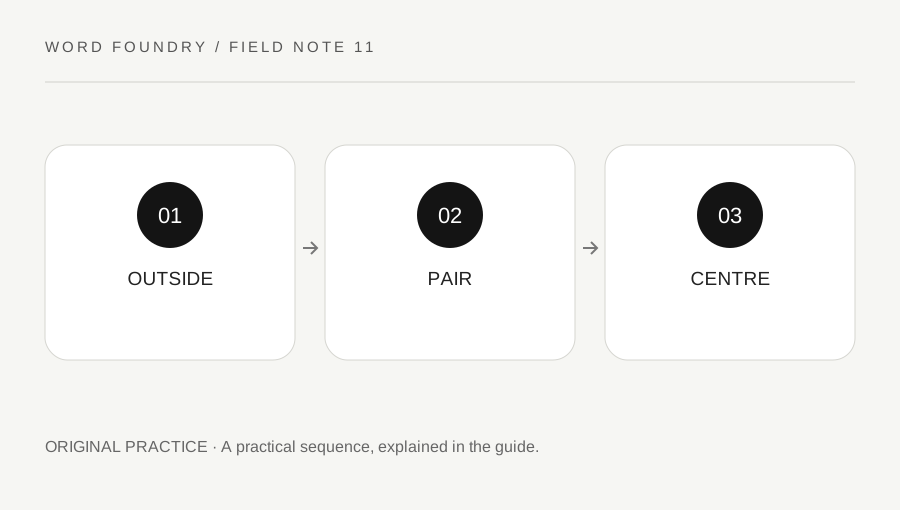
Original explanatory diagram. Numerical examples in this guide illustrate the reasoning; they are not a claim of hands-on testing.
Choose the comparison rule
For a simple word exercise, compare the letters without changing their order. Decide whether uppercase and lowercase count as equivalent. For a phrase, some exercises ignore spaces and punctuation while others compare every character. Neither rule should be hidden; write it before checking the example.
This guide uses case-insensitive letter comparison for the word examples. It does not treat a rearrangement as a palindrome. An anagram can change the order, while a palindrome keeps the sequence and compares it with its reverse. A word with repeated letters is not automatically palindromic.
Compare from both ends
Number the positions and compare first with last, second with second-last, and so on. Every pair must match. An odd-length word leaves one central letter unpaired, which causes no problem. An even-length word finishes with a central pair.
For LEVEL, L matches L and E matches E, leaving V in the centre. For LETTER, the outside L and R already differ, so the check fails immediately. You do not need to compare every remaining pair after a mismatch to know that the stated palindrome rule is not satisfied.
Separate spelling from meaning
The symmetry check is a property of the written sequence. It does not prove that the sequence is an English word or that it fits a clue. Verify vocabulary and meaning separately. An invented symmetric string can pass the pair test without being a suitable word answer.
For an original exercise, ask a learner to compare LEVEL, CIVIC, RADAR and GARDEN. Have them mark matching pairs and identify the first mismatch where present. Then ask for an original sentence using each verified word. This adds language context without borrowing a published puzzle or copying a dictionary definition.
Explain the result transparently
Write the comparison rule and one short pair trace. A response such as “LEVEL passes because positions 1 and 5 match, positions 2 and 4 match, with V central” is more informative than a bare yes. If punctuation was removed in a phrase exercise, preserve the original and normalized version so another reader can reproduce the check.
Our current helper searches patterns and racks rather than testing palindrome symmetry automatically. You can use a pattern to explore possibilities, but the paired-position check remains a separate task. Keep that boundary clear and avoid interpreting one matching list entry as proof of a broader claim about all English palindromes.
Build a pair-by-pair answer key
For CIVIC, write positions one through five. Compare C at positions one and five, then I at positions two and four. V is central. For GARDEN, compare G and N first and stop when they differ. For LEVEL, perform the same outside-in check and record the central V.
Ask a learner to make one letter change to LEVEL that breaks the property, then explain the first mismatching pair. A change to the centre alone can leave an odd-length sequence symmetric, so the chosen position matters. The resulting string may no longer be an English word; label that as a sequence experiment rather than a vocabulary answer. This makes the symmetry rule precise while preserving the separate language check. A transparent key states both what was compared and which properties were outside the exercise.
Record the first failing pair for a negative result. This gives a reviewer direct evidence instead of an unexplained label and helps distinguish symmetry checking from vocabulary recognition.
A practical checklist
Tick items for your own use. This checklist is saved only in this browser.
Questions that come up
Is any repeated-letter word a palindrome?
No. The complete sequence must match its reverse under the chosen rule. LETTER has repeated letters but fails the outside-pair check.
Does an odd-length word cause a problem?
No. After all mirrored pairs match, one central letter can remain. It maps to itself when the sequence is reversed.
Does the helper test palindromes automatically?
Not in the current version. Use the explicit pair method described here. Pattern and rack searches answer different questions.
References & scope
Background references checked on 18 October 2026. The examples and practice exercises are original editorial explanations, not copied procedures or professional advice.
- Cambridge Dictionary: word formation
- Merriam-Webster: dictionary lookup
- Merriam-Webster: official game dictionary lookup
- Cambridge: compounds and written forms
- Cambridge: colour and color usage labels
- Merriam-Webster: homophone terminology
- Merriam-Webster: palindrome terminology
- Merriam-Webster: thesaurus sense grouping